New Grants From The Chronicle
Among the highlights:
The Herb Alpert Foundation has awarded $150,000 to the Good People Fund to help grass-roots nonprofits find inventive ways to address issues of poverty, hunger, illness, disability, and well-being.

The Good People Fund
Among the highlights:
The Herb Alpert Foundation has awarded $150,000 to the Good People Fund to help grass-roots nonprofits find inventive ways to address issues of poverty, hunger, illness, disability, and well-being.
In the fall of 2010, I had recently arrived in Tel Aviv and had started my New Israel Fund Fellowship at ASSAF, a humanitarian aid organization helping asylum seekers and refugees in Israel. I met Guy around then at the ASSAF offices. He spoke English, so I explained to him that I was researching the refugee community. He quickly agreed to advise me, help me meet community leaders and translate interviews.
One evening we walked around south Tel Aviv together, discussing his future goals and desire to go to college and help his people. We entered an ad-hoc shelter where at least 100 Sudanese men slept each night. The shelter was the basement of a building that the Sudanese community had rented out. Guy and I sat there for hours, conducting a group interview with around 10 men. Guy translated for me with astounding patience and care. From the beginning, it was obvious to me that he was dedicated to helping his people.
Guy was an asylum seeker himself. During the genocide in Darfur, he fled while his village was burning down, ran for his life and left his family behind. Through a mix of luck, a friendly personality and survival skills, Guy made his way through Sudan and Egypt to Israel, where he felt he would be safe from harm. He arrived in Israel in 2008.
I stayed in Israel until December of 2011. Around that time, Guy reached out to me saying he was applying to colleges in the U.S. and asking for help. I decided to write him a recommendation letter, explaining that he had served as my translator and recounting Guy’s positive attitude and the dedication he had to his fellow Darfuris.
He was accepted to one school, the College of Lake County in Grayslake, Illinois. Someone in the admissions department had read his personal statement and had decided to take a chance. But he needed unofficial sponsors — U.S. citizens to vouch for him and tell the school they would support him financially if need be. I, along with two other people, agreed to it. We turned in our financial information to the school and they issued him a form he could use when requesting a visa, proving he had been accepted and that he had the funding he needed to attend.
I first started fundraising before Guy had a visa to come to the U.S. I managed to raise just enough for a one-way ticket from Israel by hosting a Legendary Bingo fundraiser led by a hilarious drag queen, to which only about 15 people showed up.
When I got the email that Guy had obtained a student visa from the U.S. Embassy in Israel, I was surprised. It’s literally a miracle, I told my family and friends. There was just no other explanation (and still isn’t to this day). Anna Rose Siegel, another friend of ours living in Israel at the time, helped Guy purchase his flight and I sent over the money. I knew I still would have to fundraise until Guy completed his studies because he would not be legally permitted to work in the U.S. on his student visa.
Guy is a friendly and resourceful person. The same way he reached out to me for help, he reached out to the one person he knew in Chicago — Tamar Shertok, another young Jewish American who had spent some time with asylum seekers in Tel Aviv.
Tamar wrote me that she wanted to help fundraise and together Tamar and I raised enough money to get Guy through two semesters of college. We had to cover everything — his housing, tuition, healthcare, phone, transportation, food and more.
Tamar reached out to Naomi Eisenberger, the Executive Director of the Good People Fund, and she agreed to help. The Good People Fund provides financial support, guidance, and mentoring to “charitable activities of modest proportions that are undertaken by Good People acting singly or in small groups.” They have been covering more than half of Guy’s tuition costs since his first semester. They also bought him a brand new computer when the used one he had broke.
Asked why she decided to help us help Guy, Naomi said she had been impressed by Guy’s story and his reputation in the refugee-directed NGO world. She added:
We were equally impressed with the actions of Maya Paley and Tamar Shertok who had agreed to “shepherd” Guy’s journey to the U.S. and a college career. Who would take on this extraordinary responsibility? As long as there were others who could help, we knew that our donors would be honored to be a part of this special mitzvah.
The Good People Fund believed in us and in what we had taken on and felt us worthy of their support.
But this past semester has been difficult. There were times when we did not know if we would be able to pay Guy’s rent the next month, let alone his tuition and books for school. And almost all of our personal networks have been tapped out for donations. Luckily, Alix Sherman, a psychotherapist in Chicago, stepped in to help out. She and her family took Guy in for part of the summer and have treated him like their own son. Alix’s son, a 13-year-old, even held a concert with his band and raised $3000 in one night.
We are now in the midst of Guy’s third semester and we are seeking the help of the Jewish community. A community that knows about intolerance, genocide and conflict. A community that knows that the truest miracle was when our ancestors received that little bit of help from a stranger, and that made all the difference.
Los Angeles (PRWEB) April 18, 2014
The grant will benefit several of the nearly sixty ‘good people’ led organizations that find inventive ways to address issues of poverty, hunger, illness, disability and well-being. The grant is designed to support organizations within the United States and will help many of these groups provide food, clothing, compassion and support to the programs they lead in their communities. The commitment of the grantees to do this work, to be highly effective and to be able to make an impact in the world they live in, is a core philosophy shared by both the Good People Fund and the Herb Alpert Foundation.
The Herb Alpert Foundation (http://www.herbalpertfoundation.org) is the vision of legendary musician, sculptor, painter, producer, recording industry executive and philanthropist Herb Alpert and his wife, Lani Hall.
“We are grateful for the continued support the Herb Alpert Foundation has been able to provide the Good People Fund since our inception,” explains Naomi Eisenberger, the Good People Fund’s executive director. “It is our belief, that it is most often a single person or small group of good people, responding to the problems we find in our world, who can effect change and inspire all of us to do the same. It has been our privilege to find these visionaries who often work quietly, with little fanfare and recognition, and help them grow their work. With compassionate partners like the Alperts we have been able to offer financial support and mentorship to many creative and effective programs. In so doing we have eased the burden of hunger, homelessness, disability and more for untold numbers of people.” says Eisenberger.
“One of our priorities,” explained Rona Sebastian, President of The Herb Alpert Foundation, ” is to support programs that help individuals and families in times of difficulty. Through the Good People Fund’s very strategic grant making, we are able to touch many lives in meaningful ways.”
Founded in 2008, The Good People Fund, inspired by the Jewish concept of tikkun olam (repairing the world), responds to significant problems such as poverty, disability, trauma and social isolation. The small to medium grassroots efforts we support, are leading their non-profits with annual budgets under $500,000 and no professional development staff but are driven and determined to make a difference in their communities. After all, small actions have huge impacts. With its guiding philosophy that small actions can have huge impacts and its emphasis on the personal connection, the GPF has raised and granted more than $5.4 million dollars since it was founded.
For more information on The Good People Fund or how you can support its grantees and their efforts, please contact Naomi Eisenberger at Naomi(at)goodpeoplefund(dot)org or visit their website at https://www.goodpeoplefund.org.
Contact: Rachel Litcofsky
508-314-4304 | Rachel(at)goodpeoplefund(dot)org
twitter: @goodpeoplefund | facebook.com/thegoodpeoplefund
Read the full story at http://www.prweb.com/releases/2014/04/prweb11774278.htm
Naomi Eisenberger has a background in business; she and her husband bought her father’s men’s clothing business, The Caldwell Men’s Shop, in 1982 and ran it until closing it in 1995. She has also been a teacher and a kosher caterer.
But when Rabbi Steven Bayar introduced her to the work of Danny Siegel while she was president of Congregation B’nai Israel in Millburn in the early 1990s, she fell in love. A poet and grassroots organizer, Siegel was running the Ziv Tzedaka Fund, a charity collective that disbursed millions of dollars to “mitzva heroes.” Siegel came to the synagogue as scholar-in-residence and eventually asked Eisenberger to join the staff as a volunteer.
“I felt like I had been appointed queen for the day!” she quipped. She would go on to work as a volunteer and later full-time staffer for the next 15 years.
When Ziv ended operations, the Good People Fund was one of its unofficial successors, and Eisenberger, 67, had to start from the beginning. Within one month she had commitments of $175,000 for each of two years. She envisioned the GPF as a 2.0 version of Ziv that would include more mentoring, an operation run on a sustainable business model that would outlast her.
In its first five years, GPF has funded over 60 projects, raising a total of between $4.5 million and $5 million. The goal is to split aid so that about half goes to mitzva projects in Israel, and half to recipients in the United States, although so far Israel is receiving slightly more. GPF also funds several projects in other countries.
Beyond that, recipients must address some area of social services — such as feeding the hungry and aiding those with disabilities or illnesses, Shoa survivors, seniors, veterans, or the poverty-stricken.
“None of this is rocket science, but it was all in my head. I want to build something that will continue when either God or I decide it’s time to stop,” she said. Although Siegel rarely approved funds to be used for staff salaries at recipient organizations — preferring to fund programs rather than overhead — and he limited staff at Ziv, Eisenberger sees things differently.
“There are so many programs where the founder is melting into the ground, overwhelmed. You cannot grow without the proper support. We do hand-holding and mentoring and I can tell when someone is pushed to the limit, and I won’t hesitate to provide funds to take a load off of the founder’s plate.” She does, however, keep her own staff to a Spartan two — herself and associate director Debbie Klein — and both work out of their homes to limit overhead.
Eisenberger’s goal is to have the projects she funds outgrow the GPF, which she defines as reaching and surpassing a budget of $500,000. She finds every “good person” herself, mostly by reading — newspapers, magazines, blogs, even crowd-sourcing sites on the Internet. She does not take requests. “We like to say, ‘Don’t be in touch with us; we’ll be in touch with you,’” she said.
The basic requirement for recipients is in the name itself. “You have to have good people. You have to have a visionary. There are lots of good organizations out there, but you need a vision,” said Eisenberger.
“And we will only step in when an organization has not yet attracted large donors, for the most part.” That means it must have a budget of under her magic number: half a million dollars.
“This is an exciting model with tremendous impact,” she said. “We basically take the hand of the donor and put it in the hand of the recipient without either of them knowing. That’s the best kind of personalized tzedaka.”
Eisenberger loves her work. “I get to do good stuff all day long,” she said. “I don’t know any other job like it. There is such tremendous power in being able to help people.”
http://www.njjewishnews.com/article/17754/i-get-to-do-good-stuff-all-day-long#.U5IMnPnNEml
McROBERTS, Ky. — The morning mist hovers over the narrow valley in the lush Appalachian Mountains of Kentucky. A creek rushing by the side of the main road passes through the town of Neon in once prosperous Letcher County, deep in the state’s coal mining region.
The empty storefronts reflect the industry’s losing battle with mechanization, depleted coal deposits, and cheaper-to-mine western coal. Up the road a piece, people sit in rocking chairs on the porches of mostly rundown homes watching the days go by. There are few jobs here for high school graduates — perhaps a handful at a nearby Wal-Mart or other big-box stores, or maybe a job at one of the few restaurants in town.
Teachers, with their government paychecks, form the area’s elite. In Letcher County, 26 percent of residents live below the poverty line; in smaller towns like McRoberts, up to 48.5 percent of children live in poverty and 91 percent qualify for free or reduced lunch.
On June 2, four vans filled with 16 volunteers, a combination of retirees and college or graduate students in their 20s, plus one journalist and one education specialist, pulled into the parking lot of a motel in Whitesburg, Letcher’s county seat. About 10 hours earlier, they had left their homes in Essex County, NJ — mostly Millburn/Short Hills but also Maplewood, Livingston, and towns farther west — in the early morning.
Members of Congregation B’nai Israel of Milburn and supporters of the Millburn-based Good People Fund, the volunteers had come for the fourth year in a row to assist local residents, sprucing up the trailer of a divorced woman raising three grandchildren, decluttering the rundown home of an older woman living alone, and sharing expertise with educators and families of children with autism.
It’s an unusual pairing of wealthy New Jersey suburb and struggling Appalachian town, a synagogue’s response not to a sudden natural disaster but to festering economic dysfunction, and a rare demonstration of how people from very different worlds can try — even if they do not always succeed — to create a long-term relationship.
Rabbi Steven Bayar got the whole project started when he decided he wanted to get his congregants out of their comfort zones, away from their homes, to another part of the United States.
“Every congregation raises money and is invested in tzedaka programs in their communities,” he said. “We all support organizations in Israel and some support other causes and organizations by sending money. But when we focus on what is nearby or easy we lose an important lesson — that there are those in need all over and that creating ongoing personal relationships are as important to us as to them.”
Naomi Eisenberger, a past president of B’nai Israel, coordinates the whole effort as executive director of the Good People Fund, a nearly $1 million tzedaka collective she has run out of her Millburn home since 2008.
After a few false starts in other communities, B’nai Israel, with the help of GPF, settled on McRoberts. If the town is foreign to his congregants, it is not exactly out of Bayar’s own comfort zone. Although he spent his early years in Monsey, NY, Bayar’s family moved to Charlottesville, Va., when he was in high school. Although it is a college town, Charlottesville contains pockets of rural poverty. “There were kids who didn’t come to school in the winter when it snowed because they didn’t have shoes,” he recalled.
Bayar believes strongly in mitzva projects that become ongoing relationships.
“It’s easy to go once and feel good and then forget who was there,” he said. However, a long-term commitment “creates responsibility and relationship. We are now beginning to know the people well and, because of that, they are beginning to ask us to help in ways we never envisioned. Who would have thought that they need special educators to meet with parents? We would never have thought of it — and yet, it may be the most lasting impact we have had.”
The initiative is also more complicated than a one-time mitzva day.
“More than anything else it gives perspective,” he said. “It’s hard to return from Appalachia and worry about my air-conditioning breaking down (which it did). It teaches me the meaning of resilience. The residents we work with are my teachers in life.”
During their two-and-a-half days in Kentucky, the volunteers divided into three groups. The largest would work on Saundra Hall’s home, a double-wide trailer in Seco, near McRoberts, across from what was originally the coal mine’s company store. Hall, divorced and the mother of four grown children, is raising her eldest son’s three daughters, Shayla, 10; Kennedi, 6; and Charleigh Beth, 5. Their father was sucked under by drugs; the landscape is dotted with the remains of trailers that were once crystal meth labs. Hall’s ex had raised that son; she raised the rest of the clan.
Amanda and Johnny Hall, Saundra’s oldest daughter and youngest son (her third son still works in the coal mines), were eager to help the crew as they got busy changing light fixtures, spackling, taping, and painting three rooms. Later, new carpet would be laid in four rooms. In each case, one of the volunteers with expertise took the lead and would serve as foreman.
Another group of the New Jerseyans consisted of education specialist Sara Wasserman of Livingston and two graduate students. Wasserman, who runs her own consulting company for special and typical education and coordinates professional development at Golda Och Academy’s upper school, is an instructor of inclusive early childhood education at Montclair State University. She and the students spent their time at a storefront serving as a community center in Neon, just west of McRoberts, providing training, tips, and materials to educators and families of children and teens with autism. They also taught rescue workers how to identify and manage the challenges autistic children can present in an emergency situation.
On day one, only two people showed up.
“I was disappointed and frustrated, to come all this way for one or two people,” said Wasserman, a member of Temple Beth Shalom in Livingston who grew up at B’nai Israel. And those who came were “dubious,” and “almost angry,” she said. They were “uncertain whether to trust us.”
But by day three, eight people came, and later, others who wanted to take part but could not attend for various reasons contacted Wasserman.
“Mostly, they needed someone educated in the field to come in and say they were doing the right things,” said Wasserman. “They have to travel six hours just to get a diagnosis, and there is no psychiatrist around. These are parents who are as involved, engaged, and active as any parents I’ve ever known. But they are parents without resources who can’t get their kids the help they need.”
Asked if she would return, she said, “I think I have to.”
http://www.njjewishnews.com/article/17753/those-we-work-with-are-my-teachers-in-life#.U5IN0PnNEmk
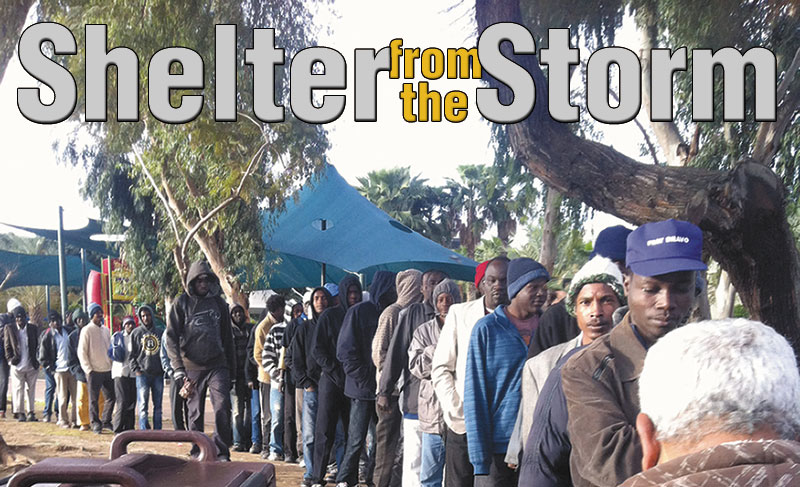 For hundreds of African refugees living in Tel Aviv, a good breakfast starts in northern New Jersey.
For two-and-a half months, the Millburn-based Good People Fund has been providing the money — $200 a day — to serve breakfast to as many as 500 people in Tel Aviv’s Levinsky Park.
The small fund channels money to small-scale, mostly volunteer charitable projects. For a number of years, the fund had helped the Tel Aviv-based African Refugees Development Center, founded by an Ethiopian political refugee in 2004.
“In February, when the situation got to be sort of critical, we started to raise funds to provide a breakfast,” explained Naomi Eisenberger, the fund’s director and sole employee.
February was when the refugee situation hit the news, after a homeless man froze to death in Levinsky Park. In response, advocates for the migrants protested in front of Prime Minister Benjamin Netanyahu’s residence with a mock coffin. Advocates said the plight of the African migrants, said to number as many as 50,000, had been aggravated by government policies designed to discourage asylum-seekers.
In a partial response, the Tel Aviv municipality quietly installed a shipping container in the park, which sheltered 50 migrants.
Since then, the politics around the Africans has grown only more heated, with prominent politicians warning they are “a cancer” on Israeli society. Some have been beaten or firebombed.
Eisenberg said that “as Americans, we really have no right to judge Israel on what they’re doing. We’re just looking at this from a humanistic point of view. These are hungry people who need to be fed until such a time as the government decides what to do.”
As it happens, one of the fund’s board members was in Tel Aviv this winter. Allen Katzoff — a Boston resident who served as director of Camp Ramah in New England and director of the Center for Adult Jewish Learning at Boston Hebrew College — is a Good People Fund board member who has been living half the year in Tel Aviv while his wife teaches at Bar-Ilan University.
It was Katzoff who met the key volunteer who makes the breakfast program possible: Gideon Ben-Ami, a retired restaurateur.
“Gideon is one of these amazing human beings,” one of the “Good People” the fund was founded to support in their charitable efforts, said Katzoff. “He goes around much of every day collecting food from various bakeries and supermarkets, where they’re going to get rid of it, and distributes it to various shelters.”
Ben-Ami had helped out a church group that was helping the refugees, and he told Katzoff that there was a real need to serve breakfast because “these people are sitting around all day long starving until the evening comes.”
So far, the breakfast program has served more than 30,000 meals.
Ben-Ami collects the food. “Without him, there would be nothing,” said Katzoff.
The actual preparation and distribution has been taken over by a small organization of the African refugees, Bnei Darfur. “Both Gideon and I were able to step back,” said Katzoff. “It’s much better if the refugees can do it themselves.”
The menu depends on what is collected.
Sometimes, it is bourekas; sometimes it is leftover pizza (not very popular among the Africans).
“What they really love is bread,” said Katzoff. “We cut it up, serve it as sandwiches with jelly or cream cheese. It fills them up.”
In the winter, they served hot tea. Now, it is an orange drink.
Because most of the meal is donated, the cost of a morning’s breakfast is only 40 cents per meal.
“We’re doing this on a month-to-month basis, as long as our funds hold out,” said Eisenberger. “Our attitude is that we have to leave politics aside. These are hungry people and they’re totally and completely helpless. Someone has to feed them. You can’t let them starve in the middle of Tel Aviv.
“All of us are very aware of the political situation and the volatility of it. Allen Katzoff, who has been spending winters there many years, said to me a while back that this is going to explode, and it has blown up. It’s distressing to see what’s happening.”
http://njjewishnews.com/article/9786/for-african-migrants-shelter-in-a-storm#.UFx5La4f_eQ